

Fixed Assets
Fixed assets are tangible assets used in a company's long-term operations, having a useful life of more than one year and a value exceeding a specified threshold. These assets support the continuity of production, service, and management processes and constitute a significant portion of the company's balance sheet.
Fixed assets include computers, vehicles, office furniture, production equipment, warehouse shelving, buildings, and other long-term-use assets.
| Criterion | Description |
|---|---|
| Tangible Form | Must have a physical presence |
| Useful Life | More than 1 year |
| Value Threshold | Must exceed the minimum value established by law |
| Purpose of Use | Must be used to generate income or support business operations |
Categories of Fixed Assets
Fixed assets are divided into various functional groups:
| Category | Examples |
|---|---|
| Buildings and Structures | Offices, warehouses, production facilities |
| Equipment | Machinery, generators, compressors |
| Vehicles | Passenger cars and trucks |
| Technical Equipment | Computers, servers, printers |
| Furniture and Fixtures | Desks, chairs, cabinets, metal shelving |
| Self-Constructed Assets | Structures assembled within the company |
| Leasehold Improvements | Investments made in leased property |
| Capital Repairs and Reconstruction | Major renovation and reconstruction works |
Formation of Fixed Assets from Materials
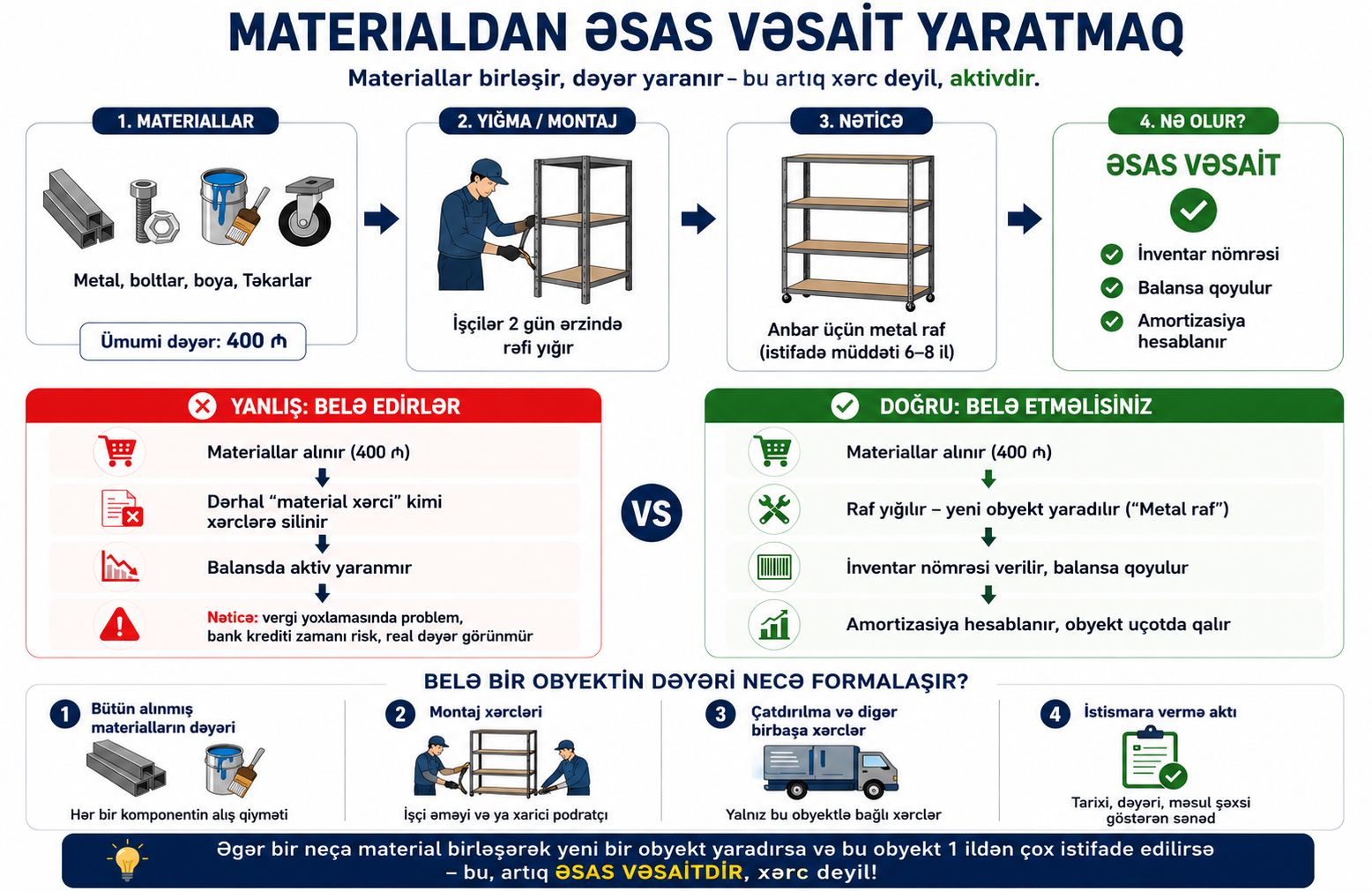
If a company uses various materials to create an asset intended for long-term use, that asset should no longer be accounted for as inventory or materials but as a fixed asset.
In this case:
-
The asset is assigned a name.
-
An inventory number is assigned.
-
The asset is recorded on the balance sheet.
-
Depreciation is calculated.
An incorrect approach is to expense all costs directly as material expenses.
| Cost Type | Included in Asset Cost |
|---|---|
| Purchase Cost of Materials | Yes |
| Assembly and Installation Costs | Yes |
| Transportation Costs | Yes |
| Documentation for Commissioning | Yes |
Importance of Inventory Numbering
Assigning a unique inventory number to each fixed asset ensures that it can be tracked throughout its entire useful life.
This system enables:
-
Tracking assets and determining their location.
-
Accurate depreciation calculations.
-
Recording repair and maintenance expenses.
-
Greater accuracy during inventory counts.
-
Confirmation of assets to banks and financial institutions.
-
Legal compliance in asset disposal and write-off procedures.
Risks of Inadequate Accounting
Improper accounting of fixed assets may create several financial and legal risks:
-
Difficulties in obtaining loans.
-
Additional collateral requirements from financial institutions.
-
Discrepancies during tax audits.
-
Risk of penalties and sanctions.
-
Incorrect valuation of the company.
Why Fixed Assets Should Not Be Expensed Immediately
When fixed assets are recognized as a direct expense:
-
The tax base is artificially reduced.
-
Financial statements do not reflect the actual situation.
-
Future cost accounting becomes more complicated.
-
Tax and audit risks increase.
Therefore, fixed assets should be allocated to expenses gradually through depreciation.
Depreciation Rates
| Category | Composition | Annual Rate |
|---|---|---|
| I | Buildings and Structures | 7% |
| II | Machinery and Equipment | 25% |
| III | Computer and Telecommunications Equipment | 25% |
| IV | Vehicles | 25% |
| V | Other Fixed Assets | 20% |
In Azerbaijan, depreciation is calculated based on the total value of assets within the same category.
Repair vs. Modernization
| Repair | Modernization |
|---|---|
| Restores the asset to its existing condition | Improves the asset's functionality |
| Replacement of worn or damaged parts | Addition of new and upgraded components |
| Recognized as a current expense | Increases the asset's carrying value |
| Not subject to depreciation | Depreciated over time after capitalization |
Recent Post




Let's discuss with you.
Accounting
Bookkeeping
Financial Accounting
Management Accounting
Cost Accounting
Auditing
Balance Sheet
Income Statement (Profit and Loss Statement)
Cash Flow Statement
Statement of Equity
Financial Reports
Assets
Liabilities
Equity
Current Assets
Fixed Assets
Intangible Assets
Current Liabilities
Long-term Liabilities
Revenue
Sales
Income
Expenses
Operating Expenses
Gross Profit
Net Profit
Loss
Journal
Ledger
Trial Balance
Debit
Credit
Accrual Accounting
Cash Basis Accounting
Depreciation
Amortization
Tax
VAT (Value Added Tax)
Income Tax
Tax Return
Compliance
Budget
Forecast
Financial Analysis
Internal Control
Inventory
Accounts Receivable
Accounts Payable
Financial Reporting
International Financial Reporting Standards (IFRS)
Generally Accepted Accounting Principles (GAAP)
Consolidated Financial Statements
Fair Value
Impairment
Cost Allocation
Variable Cost
Fixed Cost
Break-even Point
Marginal Cost
Standard Costing
Activity-Based Costing (ABC)
Capital
Share Capital
Retained Earnings
Dividends
Shareholder
Investment
Merger
Acquisition
Invoice
Receipt
Payroll
Wages
Salaries
Accrued Expenses
Prepaid Expenses
Unearned Revenue
Interest
Loan
Overdraft
Credit Risk
Liquidity
Solvency
Internal Audit
External Audit
Audit Report
Fraud
Risk Management
Financial Ratios
Liquidity Ratio
Profitability Ratio
Return on Assets (ROA)
Return on Equity (ROE)
Source Documents
Voucher
Supporting Documents
Chart of Accounts
General Journal
Subsidiary Ledger
Going Concern
Matching Principle
Consistency Principle
Materiality
Conservatism
Substance over Form
Inventory Valuation
FIFO (First In
First Out)
LIFO (Last In
First Out)
Weighted Average Cost
Stocktaking
Cost of Goods Sold (COGS)
Straight-line Method
Declining Balance Method
Useful Life
Residual Value
Capital Expenditure
Operating Expenditure
Petty Cash
Bank Reconciliation
Cash Receipts
Cash Payments
Electronic Payment
Gross Salary
Net Salary
Payroll Tax
Employee Benefits
Social Security Contributions
Statutory Requirements
Regulatory Framework
Financial Disclosure
Compliance Audit
Measurement Basis
Historical Cost
Present Value
Net Realizable Value
Valuation Allowance
Revenue Recognition
Expense Recognition
Accrued Revenue
Deferred Revenue
Matching Concept
Capitalization
Accounting Services
Bookkeeping Services
Financial Accounting Services
Management Accounting Services
Outsourced Accounting
Virtual Accounting
Financial Reporting Baku
Management Accounting Services Baku
Outsourced Accounting Baku
Virtual Accounting Baku
Financial Reporting Baku sale
Preparation of Financial Statements
Monthly Reporting
Annual Reporting
Management Reports
Tax Accounting
Tax Planning
Tax Compliance
VAT Accounting
Tax Filing
Tax Advisory
Payroll Accounting
Payroll Processing
Salary Calculation
Payroll Tax Reporting
Employee Compensation
Accounts Receivable Management
Accounts Payable Management
Cash Flow Management
Bank Reconciliation Services
Accounting Advisory
Financial Consulting
Business Advisory Services
Financial Analysis Services
Audit Support Services
Internal Control Review
Financial Due Diligence
Accounting Software
Cloud Accounting
ERP Systems
Financial Data Management
Are you ready for cooperation?
[email protected]