

Government Support for Export, Logistics, and Customs Costs: How Should Businesses Prepare?
Recent decrees signed by President Ilham Aliyev indicate that Azerbaijan is entering a new phase of economic development aimed at strengthening entrepreneurship and supporting the growth of the private sector.
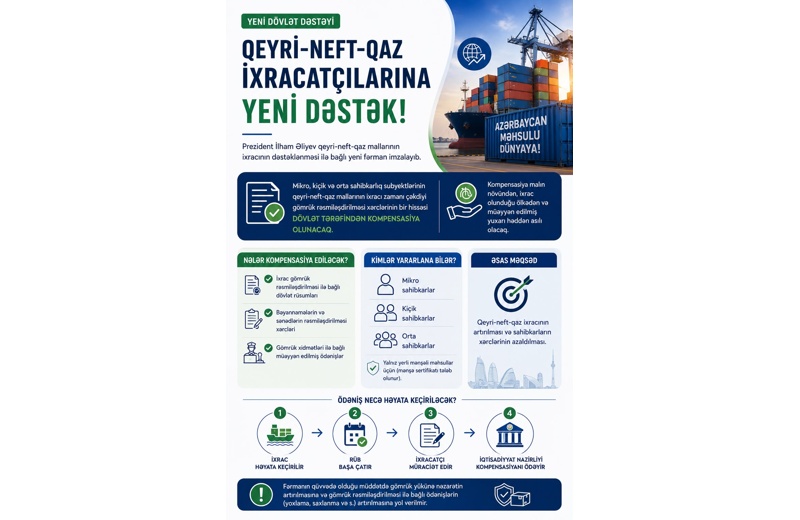
One of the latest initiatives introduces a mechanism under which the government will partially compensate customs clearance costs incurred by micro, small, and medium-sized enterprises (MSMEs) when exporting non-oil and non-gas products.
The primary objective of this initiative is to reduce exporters' financial burden, expand access to international markets, and accelerate the development of Azerbaijan's non-oil economy.
An Important Point to Understand
This is not a pre-payment mechanism.
In other words, the government will not make payments directly to customs authorities or service providers.
Instead, the program will operate on a reimbursement basis.
This means that businesses must first:
- Complete the export transaction;
- Fulfill all customs clearance procedures;
- Pay the required expenses themselves;
- Collect all supporting documentation;
- Submit an application for reimbursement afterward.
The government will compensate only those expenses that have actually been incurred and are supported by appropriate documentation.
Why Proper Accounting Matters
As a result, a well-organized accounting and documentation system is no longer simply an advantage. It is becoming a business necessity.
To qualify for reimbursement, companies must be able to substantiate:
- The local origin of the exported products;
- Certificates of origin;
- Customs documentation;
- Commercial contracts;
- Invoices;
- Payment orders;
- Bank transfer records;
- Internal financial reports.
Tax Accounting Alone Is Not Enough
Many companies in Azerbaijan currently maintain accounting primarily for tax compliance purposes.
However, tax accounting and management accounting serve different purposes.
Without a properly structured management accounting system, business owners often cannot answer essential questions such as:
- What is the actual production cost of each product?
- How much do logistics costs represent?
- Which products generate the highest profitability?
- Which export markets offer the best financial return?
- Which expenses may qualify for government reimbursement?
These insights become available only when reliable accounting and financial reporting systems are in place.
Challenges for Small Businesses
For many micro and small businesses, hiring an experienced chief accountant on a full-time basis and managing all accounting processes internally can be both difficult and costly.
For this reason, outsourcing these functions to experienced professionals is often a more efficient and practical solution.
How NFS Audit Can Help
At NFS Audit, we support businesses with:
- Setting up accounting systems from the ground up;
- Organizing tax and financial accounting;
- Preparing internal management reports;
- Audit and consulting services;
- Preparing companies to participate in government support programs.
With more than 25 years of practical experience in finance and accounting, we help businesses not only prepare reports but also improve financial management and operational efficiency.
The Key Message
Government support will increasingly depend not only on what businesses produce, but also on how accurately they document and manage their operations.
Companies should not wait until the relevant legislation officially enters into force.
Preparation should begin today.
At a minimum, by January 2026, businesses should:
- Ensure their accounting records are properly maintained;
- Implement internal management reporting systems;
- Calculate production costs accurately;
- Track logistics and export expenses separately;
- Maintain complete transparency in all documentation and business processes.
In the coming years, the businesses that benefit most from government support will not simply be manufacturers, but those that manage their financial information effectively and prepare in advance.
The government is creating new opportunities. To take full advantage of them, businesses must also be ready.
Recent Post




Let's discuss with you.
Accounting
Bookkeeping
Financial Accounting
Management Accounting
Cost Accounting
Auditing
Balance Sheet
Income Statement (Profit and Loss Statement)
Cash Flow Statement
Statement of Equity
Financial Reports
Assets
Liabilities
Equity
Current Assets
Fixed Assets
Intangible Assets
Current Liabilities
Long-term Liabilities
Revenue
Sales
Income
Expenses
Operating Expenses
Gross Profit
Net Profit
Loss
Journal
Ledger
Trial Balance
Debit
Credit
Accrual Accounting
Cash Basis Accounting
Depreciation
Amortization
Tax
VAT (Value Added Tax)
Income Tax
Tax Return
Compliance
Budget
Forecast
Financial Analysis
Internal Control
Inventory
Accounts Receivable
Accounts Payable
Financial Reporting
International Financial Reporting Standards (IFRS)
Generally Accepted Accounting Principles (GAAP)
Consolidated Financial Statements
Fair Value
Impairment
Cost Allocation
Variable Cost
Fixed Cost
Break-even Point
Marginal Cost
Standard Costing
Activity-Based Costing (ABC)
Capital
Share Capital
Retained Earnings
Dividends
Shareholder
Investment
Merger
Acquisition
Invoice
Receipt
Payroll
Wages
Salaries
Accrued Expenses
Prepaid Expenses
Unearned Revenue
Interest
Loan
Overdraft
Credit Risk
Liquidity
Solvency
Internal Audit
External Audit
Audit Report
Fraud
Risk Management
Financial Ratios
Liquidity Ratio
Profitability Ratio
Return on Assets (ROA)
Return on Equity (ROE)
Source Documents
Voucher
Supporting Documents
Chart of Accounts
General Journal
Subsidiary Ledger
Going Concern
Matching Principle
Consistency Principle
Materiality
Conservatism
Substance over Form
Inventory Valuation
FIFO (First In
First Out)
LIFO (Last In
First Out)
Weighted Average Cost
Stocktaking
Cost of Goods Sold (COGS)
Straight-line Method
Declining Balance Method
Useful Life
Residual Value
Capital Expenditure
Operating Expenditure
Petty Cash
Bank Reconciliation
Cash Receipts
Cash Payments
Electronic Payment
Gross Salary
Net Salary
Payroll Tax
Employee Benefits
Social Security Contributions
Statutory Requirements
Regulatory Framework
Financial Disclosure
Compliance Audit
Measurement Basis
Historical Cost
Present Value
Net Realizable Value
Valuation Allowance
Revenue Recognition
Expense Recognition
Accrued Revenue
Deferred Revenue
Matching Concept
Capitalization
Accounting Services
Bookkeeping Services
Financial Accounting Services
Management Accounting Services
Outsourced Accounting
Virtual Accounting
Financial Reporting Baku
Management Accounting Services Baku
Outsourced Accounting Baku
Virtual Accounting Baku
Financial Reporting Baku sale
Preparation of Financial Statements
Monthly Reporting
Annual Reporting
Management Reports
Tax Accounting
Tax Planning
Tax Compliance
VAT Accounting
Tax Filing
Tax Advisory
Payroll Accounting
Payroll Processing
Salary Calculation
Payroll Tax Reporting
Employee Compensation
Accounts Receivable Management
Accounts Payable Management
Cash Flow Management
Bank Reconciliation Services
Accounting Advisory
Financial Consulting
Business Advisory Services
Financial Analysis Services
Audit Support Services
Internal Control Review
Financial Due Diligence
Accounting Software
Cloud Accounting
ERP Systems
Financial Data Management
Are you ready for cooperation?
[email protected]