

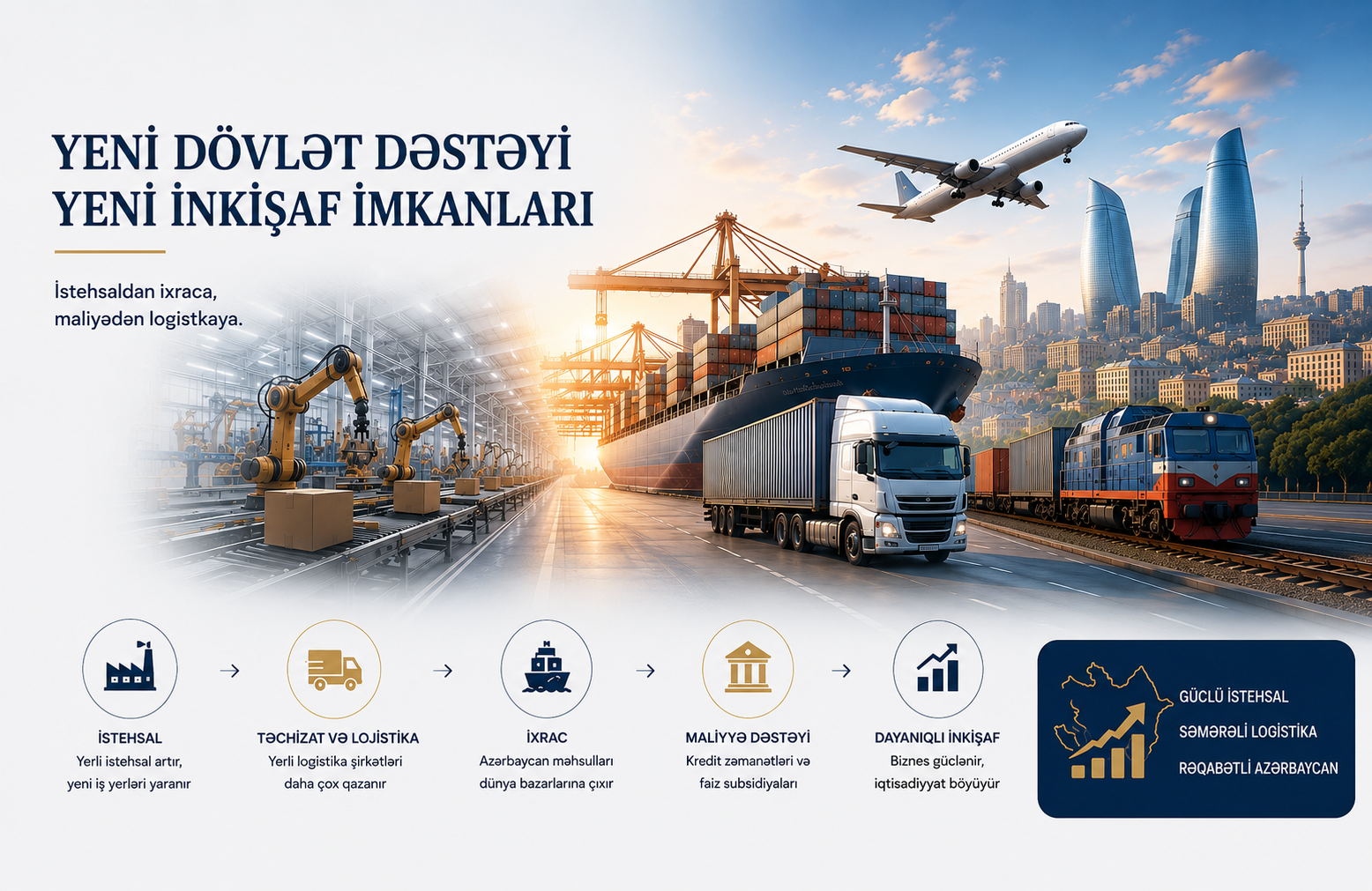
New Government Support for Businesses: New Opportunities in Export, Logistics, and Financing
The Government of Azerbaijan is introducing new support mechanisms to promote entrepreneurship, strengthen the non-oil sector, and increase exports. These initiatives are designed to reduce businesses' financial burden, improve access to financing, and enhance the competitiveness of Azerbaijani companies in international markets.
What Benefits Will Businesses Receive?
Under the new support mechanisms:
- Exports of non-oil products will receive additional government support;
- Part of transportation and logistics costs will be reimbursed;
- Additional incentives will be provided to producers operating in the Nakhchivan Autonomous Republic;
- Credit guarantees and interest subsidies will be expanded;
- The powers of the Azerbaijan Business Development Fund (ABDF) will be strengthened.
These measures are scheduled to take effect on 1 September 2026 and remain in force until 31 December 2036.
Export and Logistics Cost Support
Under the new rules, the government will reimburse part of the transportation costs incurred when exporting Azerbaijani-origin non-oil products.
The objectives of this support include:
- Increasing the international competitiveness of Azerbaijani products;
- Reducing logistics costs for exporters;
- Encouraging export activities.
How Does the Reimbursement Process Work?
Many businesses assume that the government will pay transportation costs in advance. In reality, the mechanism operates on a reimbursement basis.
Businesses must first:
- Conclude a transportation agreement;
- Pay the transportation provider;
- Complete the export transaction;
- Collect all supporting documentation;
- Submit an application for reimbursement.
The government reimburses only those expenses that have been properly documented and verified.
Why Is Proper Accounting Important?
To qualify for government support, businesses should be able to provide:
- Commercial contracts;
- Invoices;
- Bank payment records;
- Customs documentation;
- Transportation documents;
- Financial statements;
- Accounting records.
Any inconsistencies in documentation or accounting may delay or prevent reimbursement, even if the company is otherwise eligible.
How Is the Reimbursement Amount Calculated?
The reimbursement amount is determined by comparing two values:
- A specified percentage of the transportation cost;
- The maximum reimbursement limit calculated based on the customs value of the exported goods.
The company receives the lower of these two amounts.
Reimbursement Rates
| Mode of Transportation | Reimbursement Rate |
|---|---|
| Azerbaijani-registered road carrier | 70% |
| Railway transport | 70% |
| Air transport | 70% |
| Sea transport | 70% |
| Foreign-registered road carrier | 50% |
| Domestic transportation within Nakhchivan | 70% |
Additional Benefits for Businesses in Nakhchivan
The new mechanism also creates significant opportunities for producers operating in the Nakhchivan Autonomous Republic.
For example, if transportation costs amount to AZN 5,000:
- The government may reimburse AZN 3,500;
- The business would bear only AZN 1,500.
This measure is expected to improve the competitiveness of Nakhchivan-based producers.
Credit Guarantees and Interest Subsidies
Under the new presidential decrees, the administration of credit guarantees and interest subsidy programs will be entrusted to the Azerbaijan Business Development Fund (ABDF).
As a result, the following programs will be managed through a more structured framework:
- Government credit guarantees;
- Interest subsidy programs;
- Electronic application systems;
- Business support initiatives.
How Does the Interest Subsidy Work?
According to the new rules:
- The maximum eligible loan interest rate is 13%;
- The government may subsidize up to 50% of the interest expense.
For example, if a business obtains a loan of AZN 300,000 with an annual interest rate of 12%:
- Annual interest amounts to AZN 36,000;
- The government may cover AZN 18,000;
- The business pays the remaining AZN 18,000.
This significantly lowers the effective cost of borrowing.
The Key Requirement: Transparent Financial Reporting
Whether applying for export reimbursements, credit guarantees, or interest subsidies, proper documentation and transparent accounting remain the fundamental requirements.
To benefit from government support, businesses should ensure that:
- Accounting records are properly maintained;
- All transactions are fully documented;
- Payments are made through non-cash banking channels;
- Financial statements are complete and transparent.
In many cases, cash payments are not recognized as eligible expenses for government support programs.
Recent Post




Let's discuss with you.
Accounting
Bookkeeping
Financial Accounting
Management Accounting
Cost Accounting
Auditing
Balance Sheet
Income Statement (Profit and Loss Statement)
Cash Flow Statement
Statement of Equity
Financial Reports
Assets
Liabilities
Equity
Current Assets
Fixed Assets
Intangible Assets
Current Liabilities
Long-term Liabilities
Revenue
Sales
Income
Expenses
Operating Expenses
Gross Profit
Net Profit
Loss
Journal
Ledger
Trial Balance
Debit
Credit
Accrual Accounting
Cash Basis Accounting
Depreciation
Amortization
Tax
VAT (Value Added Tax)
Income Tax
Tax Return
Compliance
Budget
Forecast
Financial Analysis
Internal Control
Inventory
Accounts Receivable
Accounts Payable
Financial Reporting
International Financial Reporting Standards (IFRS)
Generally Accepted Accounting Principles (GAAP)
Consolidated Financial Statements
Fair Value
Impairment
Cost Allocation
Variable Cost
Fixed Cost
Break-even Point
Marginal Cost
Standard Costing
Activity-Based Costing (ABC)
Capital
Share Capital
Retained Earnings
Dividends
Shareholder
Investment
Merger
Acquisition
Invoice
Receipt
Payroll
Wages
Salaries
Accrued Expenses
Prepaid Expenses
Unearned Revenue
Interest
Loan
Overdraft
Credit Risk
Liquidity
Solvency
Internal Audit
External Audit
Audit Report
Fraud
Risk Management
Financial Ratios
Liquidity Ratio
Profitability Ratio
Return on Assets (ROA)
Return on Equity (ROE)
Source Documents
Voucher
Supporting Documents
Chart of Accounts
General Journal
Subsidiary Ledger
Going Concern
Matching Principle
Consistency Principle
Materiality
Conservatism
Substance over Form
Inventory Valuation
FIFO (First In
First Out)
LIFO (Last In
First Out)
Weighted Average Cost
Stocktaking
Cost of Goods Sold (COGS)
Straight-line Method
Declining Balance Method
Useful Life
Residual Value
Capital Expenditure
Operating Expenditure
Petty Cash
Bank Reconciliation
Cash Receipts
Cash Payments
Electronic Payment
Gross Salary
Net Salary
Payroll Tax
Employee Benefits
Social Security Contributions
Statutory Requirements
Regulatory Framework
Financial Disclosure
Compliance Audit
Measurement Basis
Historical Cost
Present Value
Net Realizable Value
Valuation Allowance
Revenue Recognition
Expense Recognition
Accrued Revenue
Deferred Revenue
Matching Concept
Capitalization
Accounting Services
Bookkeeping Services
Financial Accounting Services
Management Accounting Services
Outsourced Accounting
Virtual Accounting
Financial Reporting Baku
Management Accounting Services Baku
Outsourced Accounting Baku
Virtual Accounting Baku
Financial Reporting Baku sale
Preparation of Financial Statements
Monthly Reporting
Annual Reporting
Management Reports
Tax Accounting
Tax Planning
Tax Compliance
VAT Accounting
Tax Filing
Tax Advisory
Payroll Accounting
Payroll Processing
Salary Calculation
Payroll Tax Reporting
Employee Compensation
Accounts Receivable Management
Accounts Payable Management
Cash Flow Management
Bank Reconciliation Services
Accounting Advisory
Financial Consulting
Business Advisory Services
Financial Analysis Services
Audit Support Services
Internal Control Review
Financial Due Diligence
Accounting Software
Cloud Accounting
ERP Systems
Financial Data Management
Are you ready for cooperation?
[email protected]