

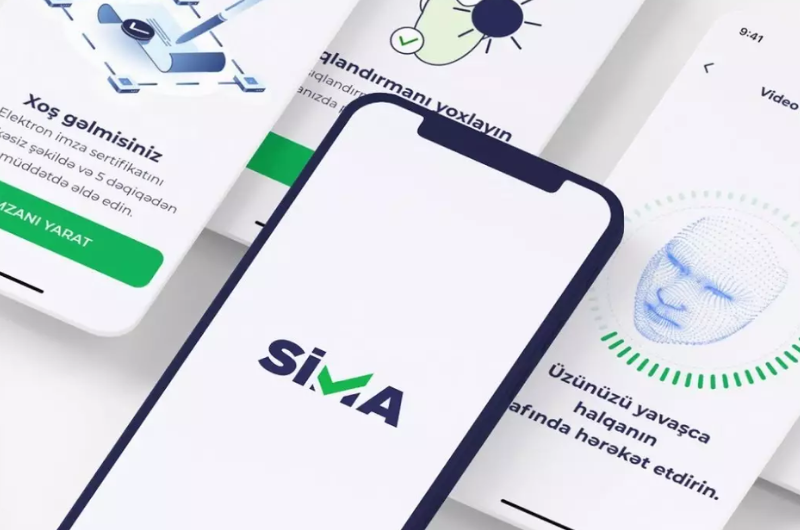
“SİMA Signature” is a next-generation, enhanced digital signature solution based on cloud technology, Public Key Infrastructure (PKI), and facial recognition technologies. Operating through a mobile application, “SİMA Signature” allows users to securely access electronic services anytime and from anywhere without the need for additional physical devices, SIM cards, or tokens.
“SİMA Signature” is designed for citizens of the Republic of Azerbaijan, individual entrepreneurs, and foreigners legally residing in the country, and it has state-recognized legal validity. The digital signature is activated through a one-time registration in the mobile application and can then be conveniently used for all electronic transactions.
This innovative solution offers numerous advantages for both citizens and service providers. With “SİMA Signature,” the use of paper documents is eliminated, documentation processes are accelerated, financial costs are reduced, and time loss is minimized. Especially for businesses, the remote signing of contracts, agreements, and other legal documents becomes more flexible and efficient.
One of the key advantages of “SİMA Signature” for partner organizations is its easy integration into any information system. Through API and technical integration solutions, banks, insurance companies, credit institutions, and other service providers can seamlessly implement “SİMA Signature” within their systems. Automated processes enable users to sign documents quickly, securely, and without limits.
For citizens, a major advantage of “SİMA Signature” is that it is completely free of charge. There is no need to visit any institution to obtain the signature — registration via the mobile application takes just 1 minute. Only an identity card is required during registration, which significantly reduces the workload for both users and partner organizations while saving time and costs.
One of the most important advantages of “SİMA Signature” in financial and legal transactions is its high level of security and reliability. This digital signature, which is legally equivalent to a handwritten signature, is based on facial recognition technology, making it impossible for one person to use another person’s signature. This minimizes fraud risks and ensures transaction transparency.
By simplifying access to digital services, “SİMA Signature” is one of the key tools supporting digital transformation and the acceleration of business processes in the country. This technology is widely used in banks and non-bank credit organizations, insurance companies, GSM operators, as well as public and private institutions, contributing to the development of a modern digital ecosystem.
Recent Post



Let's discuss with you.
Accounting
Bookkeeping
Financial Accounting
Management Accounting
Cost Accounting
Auditing
Balance Sheet
Income Statement (Profit and Loss Statement)
Cash Flow Statement
Statement of Equity
Financial Reports
Assets
Liabilities
Equity
Current Assets
Fixed Assets
Intangible Assets
Current Liabilities
Long-term Liabilities
Revenue
Sales
Income
Expenses
Operating Expenses
Gross Profit
Net Profit
Loss
Journal
Ledger
Trial Balance
Debit
Credit
Accrual Accounting
Cash Basis Accounting
Depreciation
Amortization
Tax
VAT (Value Added Tax)
Income Tax
Tax Return
Compliance
Budget
Forecast
Financial Analysis
Internal Control
Inventory
Accounts Receivable
Accounts Payable
Financial Reporting
International Financial Reporting Standards (IFRS)
Generally Accepted Accounting Principles (GAAP)
Consolidated Financial Statements
Fair Value
Impairment
Cost Allocation
Variable Cost
Fixed Cost
Break-even Point
Marginal Cost
Standard Costing
Activity-Based Costing (ABC)
Capital
Share Capital
Retained Earnings
Dividends
Shareholder
Investment
Merger
Acquisition
Invoice
Receipt
Payroll
Wages
Salaries
Accrued Expenses
Prepaid Expenses
Unearned Revenue
Interest
Loan
Overdraft
Credit Risk
Liquidity
Solvency
Internal Audit
External Audit
Audit Report
Fraud
Risk Management
Financial Ratios
Liquidity Ratio
Profitability Ratio
Return on Assets (ROA)
Return on Equity (ROE)
Source Documents
Voucher
Supporting Documents
Chart of Accounts
General Journal
Subsidiary Ledger
Going Concern
Matching Principle
Consistency Principle
Materiality
Conservatism
Substance over Form
Inventory Valuation
FIFO (First In
First Out)
LIFO (Last In
First Out)
Weighted Average Cost
Stocktaking
Cost of Goods Sold (COGS)
Straight-line Method
Declining Balance Method
Useful Life
Residual Value
Capital Expenditure
Operating Expenditure
Petty Cash
Bank Reconciliation
Cash Receipts
Cash Payments
Electronic Payment
Gross Salary
Net Salary
Payroll Tax
Employee Benefits
Social Security Contributions
Statutory Requirements
Regulatory Framework
Financial Disclosure
Compliance Audit
Measurement Basis
Historical Cost
Present Value
Net Realizable Value
Valuation Allowance
Revenue Recognition
Expense Recognition
Accrued Revenue
Deferred Revenue
Matching Concept
Capitalization
Accounting Services
Bookkeeping Services
Financial Accounting Services
Management Accounting Services
Outsourced Accounting
Virtual Accounting
Financial Reporting Baku
Management Accounting Services Baku
Outsourced Accounting Baku
Virtual Accounting Baku
Financial Reporting Baku sale
Preparation of Financial Statements
Monthly Reporting
Annual Reporting
Management Reports
Tax Accounting
Tax Planning
Tax Compliance
VAT Accounting
Tax Filing
Tax Advisory
Payroll Accounting
Payroll Processing
Salary Calculation
Payroll Tax Reporting
Employee Compensation
Accounts Receivable Management
Accounts Payable Management
Cash Flow Management
Bank Reconciliation Services
Accounting Advisory
Financial Consulting
Business Advisory Services
Financial Analysis Services
Audit Support Services
Internal Control Review
Financial Due Diligence
Accounting Software
Cloud Accounting
ERP Systems
Financial Data Management
Are you ready for cooperation?
[email protected]