

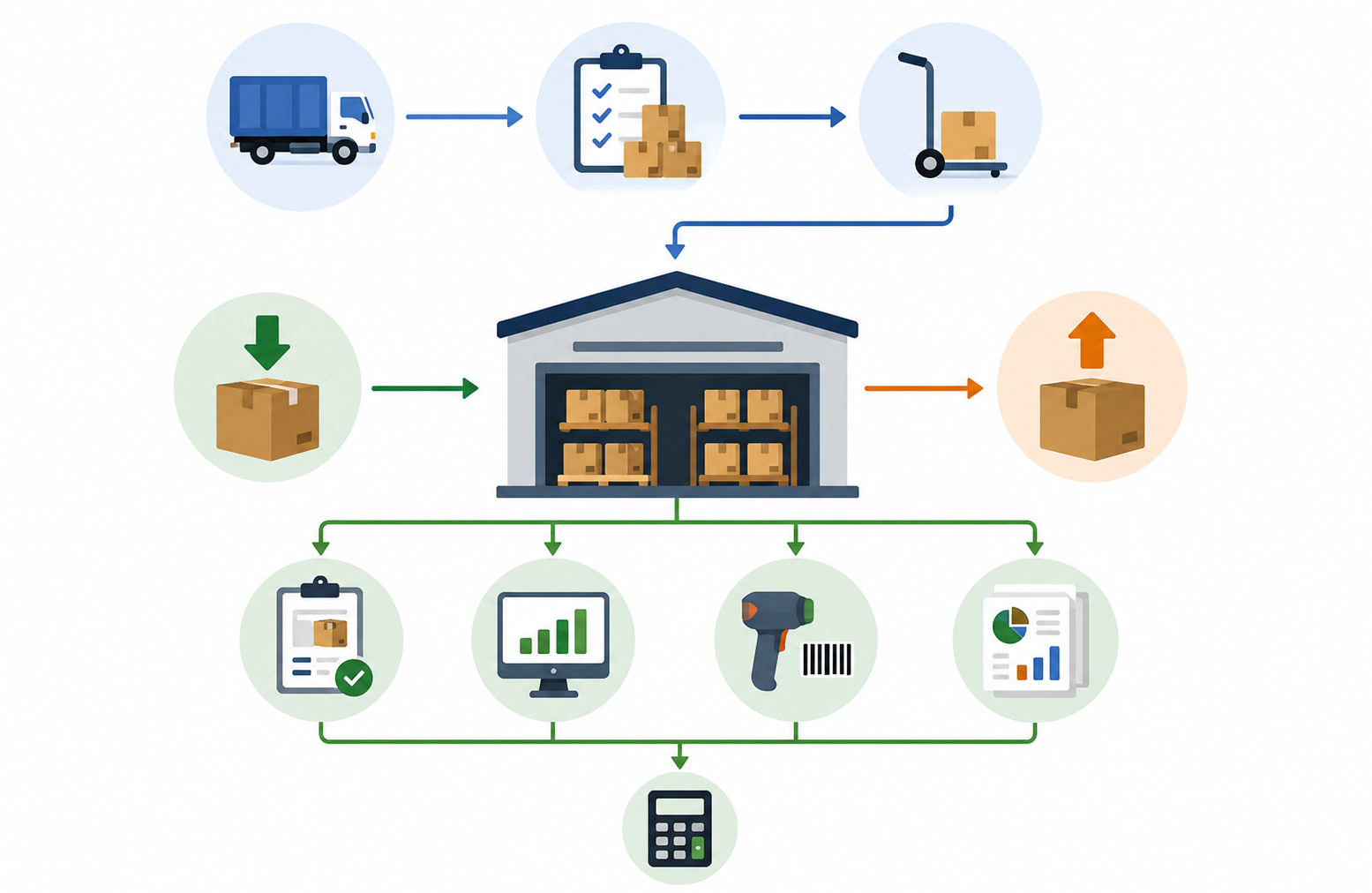
In the modern business environment, proper accounting of goods is not only an accounting requirement, but also an important management tool that ensures the financial security of the enterprise. Accurate accounting of materials entering the company, used inventories and balances in the warehouse both prevents tax risks and allows management to make the right decisions.
What Is Inventory Accounting?
Inventory accounting is the process of documenting and controlling the movement of materials entering an enterprise, used in production or in the process of activities, as well as stored in a warehouse.
This accounting system gives the enterprise the following opportunities:
- Tracking material movement;
- To identify actual warehouse balances;
- Correctly calculate the cost;
- Preparing tax returns correctly;
- Minimizing risks during tax audits.
As a result of improper accounting, the enterprise cannot track its actual reserves, financial indicators are distorted, and problems with tax authorities may arise.
On Which Accounts Are Materials Accounted For?
In accounting, materials are registered in various accounts according to their purpose. Raw materials and production materials, fuel, spare parts, building materials and other stocks are recorded separately and their movement is monitored.
This approach allows the enterprise to more accurately control both material consumption and residues.
The Role Of Documentation In Accounting For Goods
The movement of materials must necessarily be confirmed by documents. The documents that form the basis of accounting prove the receipt of material, its receipt to the warehouse, use and write-off.
The most commonly used documents are:
- M-4 form-acceptance of materials to the warehouse;
- M-11 form-release of materials from the warehouse;
- M-17 form-warehouse card and residue tracking;
- Disposal Act-clearance of used materials;
- Act of handover - transfer of materials to other persons or contractors.
Undocumented transactions become difficult to prove later, and this poses both financial and tax risks.
The Importance Of Electronic Invoice
The main supporting document for the purchase of materials in Azerbaijan is an electronic invoice (e-invoice). This document formalizes the purchase transaction, makes it possible to recognize VAT and is reflected in the information base of the tax authorities.
Purchases without electronic invoices can lead to both problems with VAT and difficulties in accounting for materials in the future.
Accounting For Materials In The Construction Sector
In the field of construction, accounting for goods and materials is of particular importance. Because work can be carried out on several objects at the same time, cooperation with different contractors and large volumes of material can be spent.
The movement of materials in the construction process is usually documented in the following stages:
- Purchase of material;
- Acceptance into the warehouse;
- Transfer to the object;
- Handing over to the sub-contractor;
- Using and deleting.
Violation of this sequence can create a discrepancy between the actual situation and the accounting data.
Inventory accounting and Income Tax Return
The indicators specified in the income tax return submitted at the end of the year should be consistent with the accounting of goods of the enterprise.
In the event of a discrepancy between purchases, used materials, cost and final balances, additional investigations may be carried out by the tax authorities. And this can lead to inspections, requests for explanations and, in some cases, financial sanctions.
Control Of Balances Of Goods In Commercial Enterprises
In enterprises engaged in commercial activities, each sales transaction must be reflected both in the cash desk and in the balance of goods.
The simple principle is this: the amount of each sale received at the checkout must correspond to the decrease in the balance of goods in the warehouse.
If the sale is recorded, but the balance of goods in the warehouse does not change, then this situation can be regarded by the tax authorities as a risky transaction.
The Most Common Errors In Accounting For Goods
In practice, enterprises often encounter the following errors:
Undocumented use of materials;
- M-11 and non-compilation of write-off acts;
- Non-compliance of warehouse residues with the actual situation;
- Improper accounting of electronic invoices;
- Differentiation of tax returns with accounting data.
These errors can subsequently cause problems in both financial statements and tax audits.
Recent Post


Let's discuss with you.
Accounting
Bookkeeping
Financial Accounting
Management Accounting
Cost Accounting
Auditing
Balance Sheet
Income Statement (Profit and Loss Statement)
Cash Flow Statement
Statement of Equity
Financial Reports
Assets
Liabilities
Equity
Current Assets
Fixed Assets
Intangible Assets
Current Liabilities
Long-term Liabilities
Revenue
Sales
Income
Expenses
Operating Expenses
Gross Profit
Net Profit
Loss
Journal
Ledger
Trial Balance
Debit
Credit
Accrual Accounting
Cash Basis Accounting
Depreciation
Amortization
Tax
VAT (Value Added Tax)
Income Tax
Tax Return
Compliance
Budget
Forecast
Financial Analysis
Internal Control
Inventory
Accounts Receivable
Accounts Payable
Financial Reporting
International Financial Reporting Standards (IFRS)
Generally Accepted Accounting Principles (GAAP)
Consolidated Financial Statements
Fair Value
Impairment
Cost Allocation
Variable Cost
Fixed Cost
Break-even Point
Marginal Cost
Standard Costing
Activity-Based Costing (ABC)
Capital
Share Capital
Retained Earnings
Dividends
Shareholder
Investment
Merger
Acquisition
Invoice
Receipt
Payroll
Wages
Salaries
Accrued Expenses
Prepaid Expenses
Unearned Revenue
Interest
Loan
Overdraft
Credit Risk
Liquidity
Solvency
Internal Audit
External Audit
Audit Report
Fraud
Risk Management
Financial Ratios
Liquidity Ratio
Profitability Ratio
Return on Assets (ROA)
Return on Equity (ROE)
Source Documents
Voucher
Supporting Documents
Chart of Accounts
General Journal
Subsidiary Ledger
Going Concern
Matching Principle
Consistency Principle
Materiality
Conservatism
Substance over Form
Inventory Valuation
FIFO (First In
First Out)
LIFO (Last In
First Out)
Weighted Average Cost
Stocktaking
Cost of Goods Sold (COGS)
Straight-line Method
Declining Balance Method
Useful Life
Residual Value
Capital Expenditure
Operating Expenditure
Petty Cash
Bank Reconciliation
Cash Receipts
Cash Payments
Electronic Payment
Gross Salary
Net Salary
Payroll Tax
Employee Benefits
Social Security Contributions
Statutory Requirements
Regulatory Framework
Financial Disclosure
Compliance Audit
Measurement Basis
Historical Cost
Present Value
Net Realizable Value
Valuation Allowance
Revenue Recognition
Expense Recognition
Accrued Revenue
Deferred Revenue
Matching Concept
Capitalization
Accounting Services
Bookkeeping Services
Financial Accounting Services
Management Accounting Services
Outsourced Accounting
Virtual Accounting
Financial Reporting Baku
Management Accounting Services Baku
Outsourced Accounting Baku
Virtual Accounting Baku
Financial Reporting Baku sale
Preparation of Financial Statements
Monthly Reporting
Annual Reporting
Management Reports
Tax Accounting
Tax Planning
Tax Compliance
VAT Accounting
Tax Filing
Tax Advisory
Payroll Accounting
Payroll Processing
Salary Calculation
Payroll Tax Reporting
Employee Compensation
Accounts Receivable Management
Accounts Payable Management
Cash Flow Management
Bank Reconciliation Services
Accounting Advisory
Financial Consulting
Business Advisory Services
Financial Analysis Services
Audit Support Services
Internal Control Review
Financial Due Diligence
Accounting Software
Cloud Accounting
ERP Systems
Financial Data Management
Are you ready for cooperation?
[email protected]