

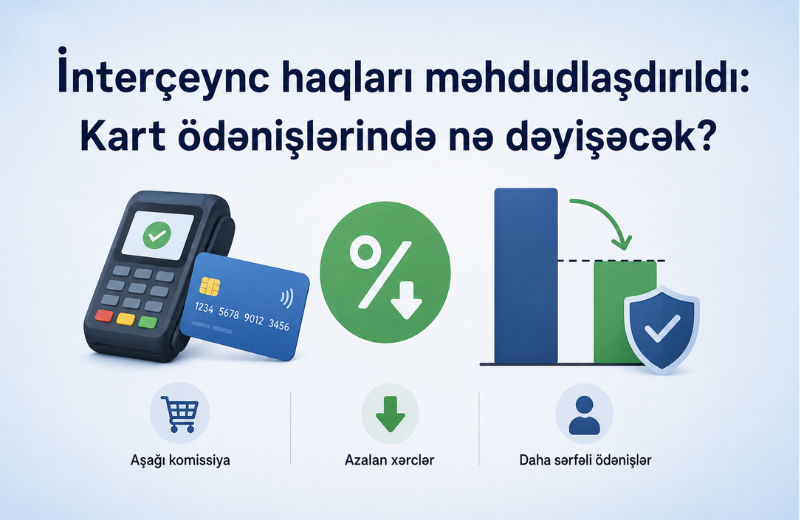
Interchange Fees Capped in Azerbaijan: What Has Changed for Card Payments?
As of 1 June 2026, new regulations governing card payments have entered into force in Azerbaijan. Under the new rules, a maximum limit has been established for the interchange fees that banks receive from card transactions.
At first glance, this may appear to be a technical change affecting only the banking sector. In reality, however, it has implications for merchants, banks, and ultimately every consumer who uses a payment card.
What Is an Interchange Fee?
Whenever you pay by card, several parties are involved in processing the transaction:
- The cardholder;
- The merchant;
- The merchant's acquiring bank;
- The bank that issued the card (the issuing bank).
When a merchant accepts a card payment, it pays a processing fee to its bank. Part of that fee is transferred to the issuing bank. This portion is known as the interchange fee.
A Simple Example
Suppose you make a purchase worth AZN 100.
- You pay AZN 100.
- The merchant pays approximately AZN 1.5-2.0 in card processing fees.
- Part of that fee is transferred to the bank that issued your card.
- The issuing bank may then use part of this revenue to fund cashback or loyalty rewards.
Although consumers do not pay interchange fees directly, merchants often incorporate these costs into the prices of goods and services.
How Did the System Work Previously?
Until now, interchange fees were largely determined according to market principles, allowing banks and payment systems considerable flexibility in setting fee levels.
In practice, interchange fees for card payments typically ranged between 1.5% and 2%. For every AZN 100 paid by card, merchants usually incurred approximately AZN 1.5-2.0 in processing costs.
What Is the Purpose of the New Regulation?
The new rules aim to:
- Make card payments more affordable for businesses;
- Reduce merchants' transaction costs;
- Encourage greater use of cashless payments;
- Lower the financial burden on small and medium-sized businesses.
Who Benefits?
Beneficiaries
- Merchants and business owners;
- Small businesses accepting card payments;
- Consumers in the long term.
Parties Potentially Affected
Banks may experience reduced interchange revenue and could therefore review cashback programs, loyalty schemes, and certain banking services.
Previously, merchants generally incorporated card processing costs into the prices of their products and services.
As a result, consumers indirectly paid these fees whenever purchasing groceries, medicines, fuel, or other goods.
What Exactly Has Changed?
Under the regulation adopted on 18 March, maximum interchange fee limits have been introduced for specific sectors of economic activity.
Banks may no longer charge interchange fees above the prescribed limits for these categories. The objective is to reduce merchants' costs, promote cashless transactions, and create a more balanced payment ecosystem.
The Largest Change: Fuel Retail
The most significant reduction applies to the fuel sector.
The maximum interchange fee for payments at fuel stations has been capped at 0.75%.
This means banks may no longer charge interchange fees exceeding this limit for card payments made at fuel stations.
The measure is expected to reduce operating costs for businesses in the fuel retail industry.
Lower Costs for Merchants
One of the most significant benefits of the reform is the reduction in card payment processing costs for merchants.
For example, a grocery retailer that previously paid approximately AZN 1.80 in fees on every AZN 100 card transaction may now pay around AZN 1.25.
This represents a saving of approximately AZN 0.55 per AZN 100 in card sales. For businesses with high transaction volumes, these savings can amount to thousands of manats annually.
International Experience: The Durbin Amendment
One of the most notable international examples is the Durbin Amendment introduced in the United States, which substantially reduced debit card interchange fees.
However, the expected reduction in retail prices did not fully materialize.
Many merchants retained the savings rather than lowering prices, while banks compensated for lost revenue by reducing cashback programs and limiting certain free banking services.
As a result, the overall economic burden did not disappear but was redistributed within the payment system and, in many cases, ultimately borne by consumers.
This experience demonstrates that regulating interchange fees alone does not automatically lead to lower prices.
What Determines the Real Impact?
Introducing interchange fee caps is an important step in the right direction, but it is not sufficient on its own to guarantee lower consumer prices.
Three additional factors are essential:
1. Effective Market Competition
If competition is weak, businesses may retain the savings rather than passing them on to consumers through lower prices.
2. Active Regulatory Oversight
The effectiveness of the reform must be continuously monitored. Adopting legislation is only the first step; its practical impact should also be evaluated.
3. Consumer Awareness
Well-informed consumers make better purchasing decisions and create competitive pressure that encourages greater price transparency.
Recent Post




Let's discuss with you.
Accounting
Bookkeeping
Financial Accounting
Management Accounting
Cost Accounting
Auditing
Balance Sheet
Income Statement (Profit and Loss Statement)
Cash Flow Statement
Statement of Equity
Financial Reports
Assets
Liabilities
Equity
Current Assets
Fixed Assets
Intangible Assets
Current Liabilities
Long-term Liabilities
Revenue
Sales
Income
Expenses
Operating Expenses
Gross Profit
Net Profit
Loss
Journal
Ledger
Trial Balance
Debit
Credit
Accrual Accounting
Cash Basis Accounting
Depreciation
Amortization
Tax
VAT (Value Added Tax)
Income Tax
Tax Return
Compliance
Budget
Forecast
Financial Analysis
Internal Control
Inventory
Accounts Receivable
Accounts Payable
Financial Reporting
International Financial Reporting Standards (IFRS)
Generally Accepted Accounting Principles (GAAP)
Consolidated Financial Statements
Fair Value
Impairment
Cost Allocation
Variable Cost
Fixed Cost
Break-even Point
Marginal Cost
Standard Costing
Activity-Based Costing (ABC)
Capital
Share Capital
Retained Earnings
Dividends
Shareholder
Investment
Merger
Acquisition
Invoice
Receipt
Payroll
Wages
Salaries
Accrued Expenses
Prepaid Expenses
Unearned Revenue
Interest
Loan
Overdraft
Credit Risk
Liquidity
Solvency
Internal Audit
External Audit
Audit Report
Fraud
Risk Management
Financial Ratios
Liquidity Ratio
Profitability Ratio
Return on Assets (ROA)
Return on Equity (ROE)
Source Documents
Voucher
Supporting Documents
Chart of Accounts
General Journal
Subsidiary Ledger
Going Concern
Matching Principle
Consistency Principle
Materiality
Conservatism
Substance over Form
Inventory Valuation
FIFO (First In
First Out)
LIFO (Last In
First Out)
Weighted Average Cost
Stocktaking
Cost of Goods Sold (COGS)
Straight-line Method
Declining Balance Method
Useful Life
Residual Value
Capital Expenditure
Operating Expenditure
Petty Cash
Bank Reconciliation
Cash Receipts
Cash Payments
Electronic Payment
Gross Salary
Net Salary
Payroll Tax
Employee Benefits
Social Security Contributions
Statutory Requirements
Regulatory Framework
Financial Disclosure
Compliance Audit
Measurement Basis
Historical Cost
Present Value
Net Realizable Value
Valuation Allowance
Revenue Recognition
Expense Recognition
Accrued Revenue
Deferred Revenue
Matching Concept
Capitalization
Accounting Services
Bookkeeping Services
Financial Accounting Services
Management Accounting Services
Outsourced Accounting
Virtual Accounting
Financial Reporting Baku
Management Accounting Services Baku
Outsourced Accounting Baku
Virtual Accounting Baku
Financial Reporting Baku sale
Preparation of Financial Statements
Monthly Reporting
Annual Reporting
Management Reports
Tax Accounting
Tax Planning
Tax Compliance
VAT Accounting
Tax Filing
Tax Advisory
Payroll Accounting
Payroll Processing
Salary Calculation
Payroll Tax Reporting
Employee Compensation
Accounts Receivable Management
Accounts Payable Management
Cash Flow Management
Bank Reconciliation Services
Accounting Advisory
Financial Consulting
Business Advisory Services
Financial Analysis Services
Audit Support Services
Internal Control Review
Financial Due Diligence
Accounting Software
Cloud Accounting
ERP Systems
Financial Data Management
Are you ready for cooperation?
[email protected]